

Artificial Intelligence and the Future of Human Agency
The challenge before modern society is not merely technological literacy, it is moral literacy.

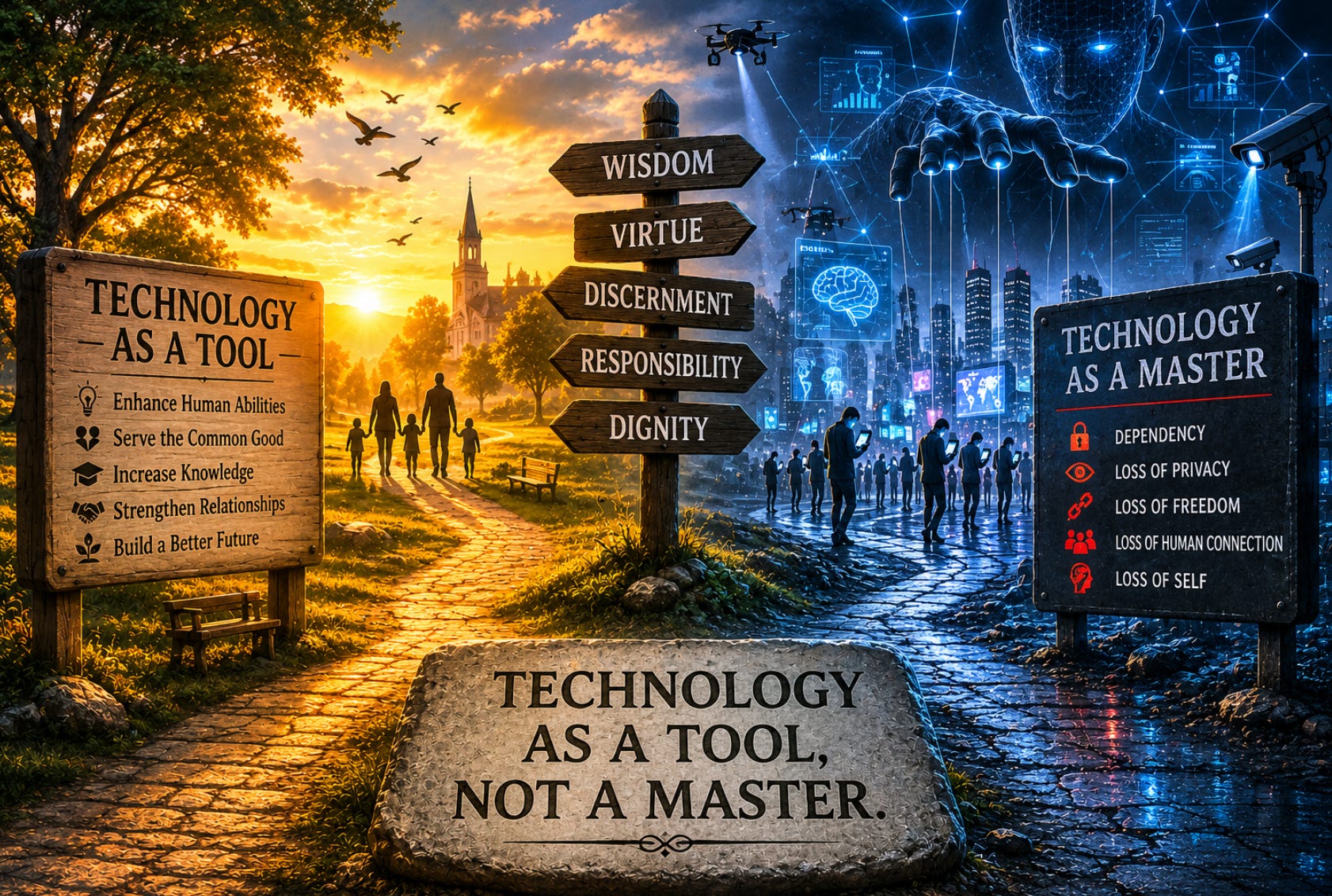
Technology as a Tool, Not a Master
The digital revolution has entered a new phase. Artificial intelligence, machine learning, robotics, autonomous systems, predictive analytics, and advanced automation are rapidly reshaping every sector of modern society. Unlike previous technological innovations that primarily enhanced human physical capabilities, artificial intelligence increasingly augments cognitive functions once reserved exclusively for human beings.
AI systems now draft documents, analyze complex datasets, diagnose medical conditions, generate artwork, assist legal research, predict consumer behavior, identify criminal suspects, and engage in sophisticated conversation. Robotics continue to expand beyond industrial settings into healthcare, transportation, logistics, manufacturing, public safety, and military applications.
The question facing society is no longer whether artificial intelligence will transform civilization. It already has.
The more important question is whether humanity will remain master of these technologies or gradually become subordinate to them.
Technology itself is morally neutral. Like any tool, its impact depends upon the character, intentions, and wisdom of those who wield it. The printing press could disseminate Scripture or propaganda. The internet can provide education or misinformation. Artificial intelligence can advance human flourishing or amplify human dysfunction.
For this reason, the central challenge of the AI revolution is not technological. It is moral.
The issue is whether technological capability will be accompanied by sufficient wisdom, virtue, accountability, and ethical restraint.
From this perspective, AI represents another test of whether society possesses the formation necessary to govern its own creations.
Predictive Policing and the Promise of Data
Few professions stand to benefit more from artificial intelligence than law enforcement.
Modern policing generates enormous quantities of information. Crime reports, body-camera footage, surveillance systems, criminal intelligence files, digital evidence, forensic records, dispatch logs, social media activity, geographic information systems, and public safety databases create a volume of information impossible for human analysts to process efficiently without technological assistance.
Artificial intelligence offers significant advantages in managing these data streams.
Predictive policing systems use machine learning algorithms to identify crime patterns, forecast potential criminal activity, and assist agencies in allocating resources more effectively. Through hotspot analysis, predictive modeling, and data mining, computers analyze historical crime data, environmental variables, temporal trends, and geographic characteristics to identify locations where offenses are statistically more likely to occur. Such systems allow agencies to deploy personnel proactively rather than reactively.
Environmental criminology has long recognized that criminal activity follows identifiable patterns. Crime clusters around opportunity structures, routine activities, and environmental vulnerabilities. Artificial intelligence simply provides a more sophisticated method of identifying these relationships.
The potential benefits are substantial:
Improved resource deployment
Faster identification of emerging crime trends
Enhanced intelligence analysis
Better allocation of limited personnel
Increased crime prevention opportunities
Improved officer safety
Yet predictive technologies are not without risk.
Data can contain errors. Historical records may reflect previous biases. Algorithms reflect assumptions made by programmers and analysts. Predictive systems may unintentionally reinforce flawed conclusions if not subjected to continuous review and validation.
For this reason, artificial intelligence should inform professional judgment rather than replace it.
Technology can identify patterns.
Wisdom determines what those patterns mean.
Surveillance and the Expansion of Technological Power
Artificial intelligence has dramatically expanded the capabilities of modern surveillance systems.
Facial recognition technology can identify individuals within large crowds. Automated license plate recognition systems can track vehicle movement across entire regions. Social media analytics platforms can identify networks, relationships, communication patterns, and emerging threats. Advanced sensor systems can collect and process information at a scale previously unimaginable.
Unmanned aerial vehicles (UAVs), commonly known as drones, provide law enforcement agencies with aerial surveillance capabilities useful for search-and-rescue operations, accident reconstruction, disaster response, crowd monitoring, tactical operations, and crime scene investigations. Sophisticated models equipped with thermal imaging, zoom cameras, GPS-guided mapping systems, and three-dimensional imaging technology provide actionable intelligence in real time.
Similarly, robotic systems increasingly allow officers to safely assess dangerous environments. Remote-operated robotic cameras can enter confined spaces, barricaded structures, hazardous environments, or active crime scenes while transmitting visual and audio intelligence back to officers operating from secure positions. Some systems are portable or even throwable, reducing risk to personnel while enhancing situational awareness.
These technologies save lives.
They protect officers.
They locate missing persons.
They improve investigative capabilities.
They enhance public safety.
Yet every increase in governmental capability requires corresponding safeguards.
The American constitutional framework recognizes that power must be balanced by accountability. Privacy rights, due process protections, judicial oversight, and Fourth Amendment safeguards remain essential regardless of technological advancement.
The challenge is not preventing technological innovation.
The challenge is ensuring that innovation remains subordinate to constitutional principles.
Technology must serve liberty rather than diminish it.
Robotics and the Future Workforce
The emergence of advanced robotics represents one of the most significant economic transformations since the Industrial Revolution.
Robotic systems are increasingly capable of performing tasks once requiring human labor. Autonomous vehicles, warehouse automation systems, manufacturing robots, delivery systems, medical robotics, and service-sector machines continue to expand across industries.
Public attention has increasingly focused on humanoid robotics. Tesla’s Optimus project exemplifies these developments. Elon Musk has predicted that humanoid robots may eventually perform millions of jobs currently conducted by human workers, fundamentally altering labor markets and economic structures.
For many occupations, automation promises substantial benefits.
Dangerous tasks may be assigned to machines rather than humans.
Workplace injuries may decline.
Productivity may increase.
Operational costs may decrease.
Labor shortages may be mitigated.
Yet economic questions are only part of the equation.
Human work possesses value beyond compensation.
Work teaches discipline.
Work fosters responsibility.
Work develops competence.
Work creates purpose.
Work contributes to human dignity.
A society that increasingly automates labor must carefully consider how future generations will continue developing the virtues historically cultivated through meaningful work.
The question is not whether robots will replace certain jobs.
The question is whether society will preserve opportunities for human flourishing as those changes occur.
The Outsourcing of Human Judgment
Perhaps the greatest risk posed by artificial intelligence is not automation but dependency.
Human beings increasingly rely upon technology to remember information, navigate cities, organize schedules, select entertainment, evaluate products, interpret news, and formulate opinions. AI promises to simplify many cognitive tasks that once required effort, concentration, and independent thought.
Convenience is attractive.
But convenience often reduces the necessity of intellectual engagement.
Critical thinking requires effort.
Discernment requires effort.
Judgment requires effort.
Wisdom requires effort.
The danger is not that artificial intelligence will think for us.
The danger is that people may gradually stop thinking for themselves.
A society that increasingly delegates judgment to algorithms risks becoming technologically sophisticated yet intellectually dependent. Information becomes abundant while understanding becomes scarce.
Artificial intelligence can rapidly generate answers.
It cannot determine whether those answers are morally right.
The distinction between information and wisdom remains one of the defining challenges of the digital age.
The Understanding of Human Dignity
The Catholic Church approaches artificial intelligence from a fundamentally different perspective than most technological discussions.
Technology often begins by asking:
“What can we create?”
Catholic anthropology begins by asking:
“What is the human person?”
The answer is foundational.
Human beings are created in the image and likeness of God (Genesis 1:27). Human dignity is not derived from intelligence, productivity, efficiency, or usefulness. Human dignity derives from being intentionally created by God and destined for eternal communion with Him.
This distinction has profound implications for artificial intelligence.
Machines may simulate reasoning.
They may mimic language.
They may perform analysis.
They may generate content.
Yet they do not possess souls.
They do not exercise authentic moral agency.
They do not experience love, sacrifice, mercy, repentance, or redemption.
They cannot participate in the transcendent realities that define human existence.
The Church therefore welcomes technological advancement while insisting that all technology remain subordinate to human dignity, moral responsibility, and the common good.
Human beings must never become instruments of their own inventions.
Technology exists to serve persons.
Persons do not exist to serve technology.
The emergence of artificial intelligence has already prompted significant reflection within the Catholic Church.
Pope Leo XIV has identified artificial intelligence as one of the defining moral issues of the modern era. Drawing parallels to the social disruptions addressed by Pope Leo XIII during the Industrial Revolution, he has emphasized the need to ensure that technological innovation remains grounded in human dignity and the common good.
The Church’s concern is not opposition to innovation.
Catholicism has historically embraced science, education, medicine, and technological progress.
Rather, the concern involves the temptation to reduce human beings to economic units, data points, or programmable systems.
Artificial intelligence raises questions involving:
Human labor
Truth and information
Privacy and surveillance
Economic justice
Human relationships
Moral accountability
Human identity
The Church insists that technological progress cannot become detached from moral responsibility.
The future of artificial intelligence must remain guided by ethics rather than efficiency alone.
AI as Assistant, Not Authority
One of the greatest mistakes modern society may make is viewing artificial intelligence as either a replacement for human judgment or an independent source of truth.
A more useful understanding is to view AI as a highly capable virtual graduate assistant operating under human supervision. Perhaps even a better explanation is an intellectual force multiplier.
Like a graduate assistant working under an experienced professor, researcher, physician, attorney, executive, or criminal investigator, AI can gather information, organize research, identify patterns, summarize findings, and suggest avenues for further inquiry. It can dramatically improve efficiency and expand access to information.
Yet it remains subordinate to the wisdom, experience, ethical judgment, and accountability of the person directing the work.
Artificial intelligence possesses neither conscience nor moral responsibility.
It cannot exercise prudence.
It cannot distinguish virtue from vice.
It cannot love.
It cannot sacrifice.
It cannot forgive.
It cannot assume accountability for its actions.
Most importantly, it cannot possess wisdom because wisdom requires the integration of truth, experience, morality, and purpose.
As an applied criminologist, former sheriff, state trooper, and special agent, I spent decades reviewing intelligence reports, criminal investigations, witness statements, forensic evidence, and crime data. Information alone never solved a case.
Judgment solved the case.
Experience solved the case.
Ethical decision-making solved the case.
Information merely informed those decisions.
Artificial intelligence should occupy the same role.
It should assist human beings.
It should not replace them.
The proper relationship is not machine over man.
Nor is it man versus machine.
The proper relationship is man directing machine.
The Formed Man uses artificial intelligence as a force multiplier for learning, productivity, creativity, and service while maintaining responsibility for every decision.
The Feral Man gradually surrenders independent thought to technological convenience until automation replaces judgment and dependency replaces wisdom.
Formation in the Age of Artificial Intelligence
Artificial intelligence will continue to advance.
Robotics will become more sophisticated.
Algorithms will become more influential.
Digital systems will become increasingly integrated into daily life.
These developments are inevitable.
The more important question is whether human formation advances alongside technological capability.
Technology amplifies what already exists.
If society is virtuous, technology can enhance human flourishing.
If society is disordered, technology can accelerate disorder.
Artificial intelligence can strengthen education or spread misinformation.
It can improve public safety or facilitate surveillance abuses.
It can assist families or isolate individuals.
It can support formation or intensify ferality.
Ultimately, the future of artificial intelligence will not be determined by machines.
It will be determined by the moral character of the people using them.
The challenge before modern society is therefore not merely technological literacy.
It is moral literacy.
The Formed Man retains mastery over his attention, judgment, relationships, and conscience regardless of technological advancement.
The Feral Man becomes captive to the very tools he created.
Artificial intelligence may transform civilization.
Only virtue can preserve it.
References
Barrat, J. (2013). Our final invention: Artificial intelligence and the end of the human era. St. Martin’s Press.
Bostrom, N. (2014). Superintelligence: Paths, dangers, strategies. Oxford University Press.
Catechism of the Catholic Church. (1997). Libreria Editrice Vaticana.
Dicastery for the Doctrine of the Faith & Dicastery for Culture and Education. (2025). Antiqua et Nova: Note on the relationship between artificial intelligence and human intelligence. Vatican City.
Ferguson, A. G. (2017). The rise of big data policing: Surveillance, race, and the future of law enforcement. New York University Press.
Genesis 1:27. New American Bible Revised Edition.
Perry, W. L., McInnis, B., Price, C. C., Smith, S. C., & Hollywood, J. S. (2013). Predictive policing: The role of crime forecasting in law enforcement operations. RAND Corporation.
Russell, S. (2019). Human compatible: Artificial intelligence and the problem of control. Viking.
Sharkey, N. (2020). The ethical frontiers of artificial intelligence and robotics. AI & Society, 35(2), 287–295.
Zuboff, S. (2019). The age of surveillance capitalism: The fight for a human future at the new frontier of power. PublicAffairs.
About the Author:
Sheriff (Ret) Currie Myers, MBA, PhD, is a retired major county sheriff, former KBI special agent, and Kansas state trooper with a five-year assignment to the U.S. Department of Justice, Drug Enforcement Administration (DEA). Following his retirement from law enforcement, he served as a senior project manager for the Wexford Group, a contractor to the the U.S. Department of Defense, specializing in national security and asymmetrical threat environments.
In addition to running one of the largest sheriff’s offices in the Midwest, Dr. Myers is also an applied criminologist whose work centers on criminal justice public policy, organizational behavior, and professional ethics. He has held leadership roles in academia as a school dean and taught at both the undergraduate and graduate levels in criminology, leadership, management, public administration, and business.
With over 1,000 law enforcement officers trained across 30 states, Dr. Myers was a nationally recognized court and training expert in synthetic drug investigations and clandestine laboratory response. During his long tenure at the KBI, he work in the special operations division and then ran the Clandestine Laboratory Response Team (CLRT), during a time period in which Kansas was often referred to as the “Meth Capitol of the World.” During his tenure, Myers also worked in the field division where he focused on death investigations, police shootings, and corruption cases. He is the author of two books: The Meth Handbook, a practical guide to meth lab investigations, and “The Advent of Feral Man”, which explores the evolution of criminal archetypes in modern society. Myers is working on a new book called, “The Return from Feral Man” with a planned release in late 2026 or early 2027.
Dr. Myers’ published works, media appearances, and radio broadcasts—including his show America’s Criminologist with Dr. Currie Myers on ABC News/Radio affiliate KMET in San Bernardino—can be found on his Substack at drcurriemyers.substack.com. The show is available on all major streaming platforms.
Contact Dr Myers directly via this page for speaking engagements or training on a myriad of topics.